The Digital State: SnipeSearch 2015-2020
A comprehensive reconstruction of five years of service expansion, infrastructure sovereignty, community building, and the painful lessons of partnership dependence
By January 2015, SnipeSearch had transitioned from the restrictive Orbit meta-system to fully sovereign infrastructure. Network sovereignty was anchored by the registration of PCGUYS as a dedicated Internet Service Provider (ISP).
This hardware density and network independence served as the bedrock for five years of aggressive service diversification, technical experimentation, and community development. But the period was also marked by painful lessons about the dangers of relying on external partnerships, lessons that would fundamentally shape the organization’s philosophy about infrastructure sovereignty and the critical importance of owning the entire technical stack.
2015: Financial Independence Through AdClicks
On November 10, 2015, the organization formalized its revenue model with the launch of SnipeSearch AdClicks, a self-serve advertising platform designed to bypass industry-standard ‘black box’ algorithms that prioritized raw volume over human intent. AdClicks provided advertisers with a transparent alternative focused on high-precision targeting and aggressive bot mitigation.
The platform’s performance metrics revealed stark differences from mainstream competitors. While traditional ad networks suffered from invalid traffic (IVT) rates approaching 30%, the SnipeSearch environment maintained IVT below 1% through a multi-layered verification stack.
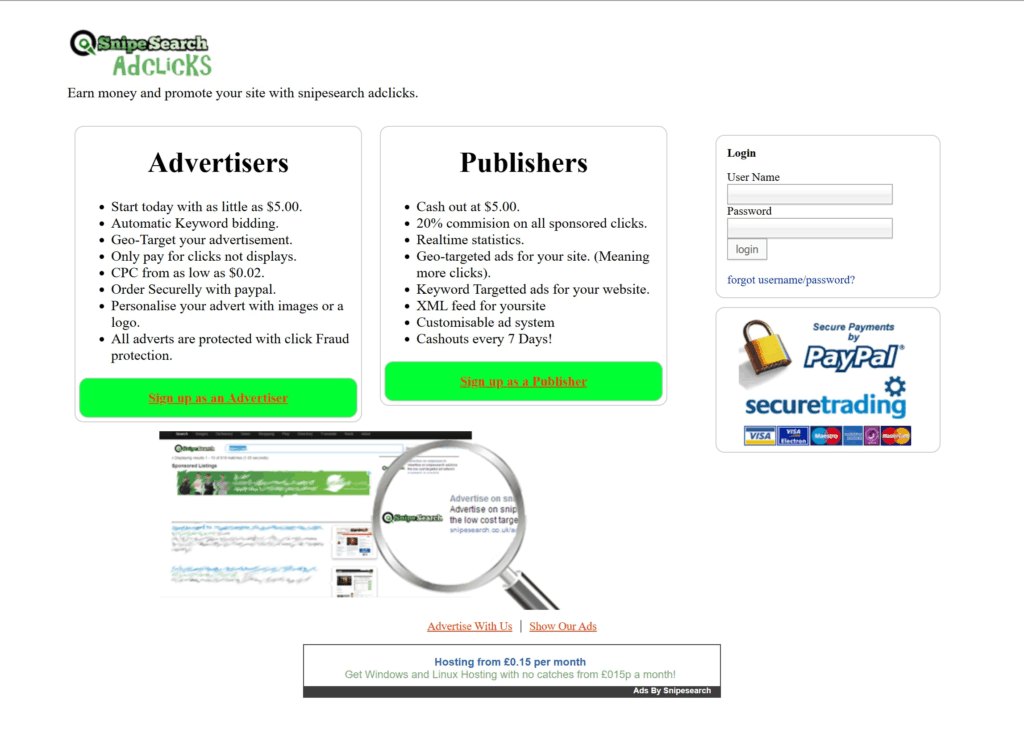
The verification architecture consisted of three primary components: Cryptographic Proof-of-Work challenges that forced visitor devices to perform background cryptographic calculations, making large-scale botnet activity prohibitively expensive through computational cost rather than detection; CSS honeypots deploying hidden form fields to trap and exclude automated scrapers that blindly filled all form elements; and jurisdictional precision that prioritized human traffic from established financial hubs like Gibraltar, Switzerland, and the UAE while avoiding high-CTR but low-intent emerging markets often exploited by automated bidding systems fulfilling click quotas.
Under the Effective Cost per Human Click (eCPHC) formula, SnipeSearch delivered verified human traffic at approximately £0.10 per click compared to £0.79 effective cost on mainstream platforms. This wasn’t marketing spin but mathematical reality: advertisers received 87% cost savings while simultaneously getting higher-quality traffic from real humans in markets with actual purchasing power.
By December 2016, promotional campaigns announced that ads reached 12 million users monthly at 5 cents per click. The organization demonstrated confidence in platform effectiveness through aggressive promotional offers: $25 advertising vouchers to early adopters reaching 100 page likes on Snipesocial. The logic was sound – if the platform delivered real conversions, trial users would become paying customers, making the voucher cost an acceptable customer acquisition expense.
2016: The Year of Explosive Growth and Painful Losses
2016 was paradoxical: the most aggressive service expansion period in ecosystem history, launching multiple major services while simultaneously experiencing one of the most devastating infrastructure losses the organization would ever face.
April 7, 2016: Snipe Rank Launches
Snipe Rank launched as a website ranking system allowing users to integrate ranking codes into their own websites for indexing within the Snipe ecosystem. Unlike Alexa’s cookie-based tracking, Snipe Rank used image-based verification from the beginning, a technical decision that prioritized user privacy while still providing accurate ranking data.
This service enabled external site owners to participate directly in the search network, expanding the platform’s reach beyond centrally-indexed content. The ranking system provided website owners with visibility into their site’s performance within the SnipeSearch ecosystem, creating incentives for optimization and engagement with the platform.
Snipe Rank would continue operating through this form until April 7, 2022 (exactly six years later), when it transformed into rommie.net, a massively inclusive security tool combining ranking functionality with free security badges and monthly virus scans for users. But during 2016-2020, it served purely as a ranking system analogous to Alexa, providing website performance metrics within the SnipeSearch universe.
April 15, 2016: Snipesearch Music Goes Live
SnipeSearch Music went live as a full-featured music streaming service offering completely uninterupted listening with access to hundreds of thousands of tracks. Unlike competitors like Spotify’s free tier or YouTube Music, SnipeSearch Music provided uninterrupted listening without forced advertisements, periodic interruptions, or degraded audio quality for non-paying users, the website itself simply shows non intrusive visual ads in the template.
The service offered comprehensive playlist creation allowing users to curate collections according to personal taste, mood-based organization, or thematic grouping. Playlists could be shared with friends, creating social aspects around music discovery and shared listening experiences. Music videos were integrated into the platform, providing visual content alongside audio tracks and enabling users to engage with music across multiple sensory dimensions.
By September 2017, social posts promoted music.snipesearch.co.uk as offering ‘hundreds of thousands of tracks, without forced ads.’ The service positioned itself as a genuine alternative to mainstream platforms, competing on the privacy and ad-free experience rather than attempting to match the catalog sizes of Spotify or Apple Music.
The SnipeSearch Mail Catastrophe: 2016-2017
While new services launched successfully, 2016 brought devastating news: the complete collapse of SnipeSearch Mail, a service that had been a central component of the ecosystem since 2011.
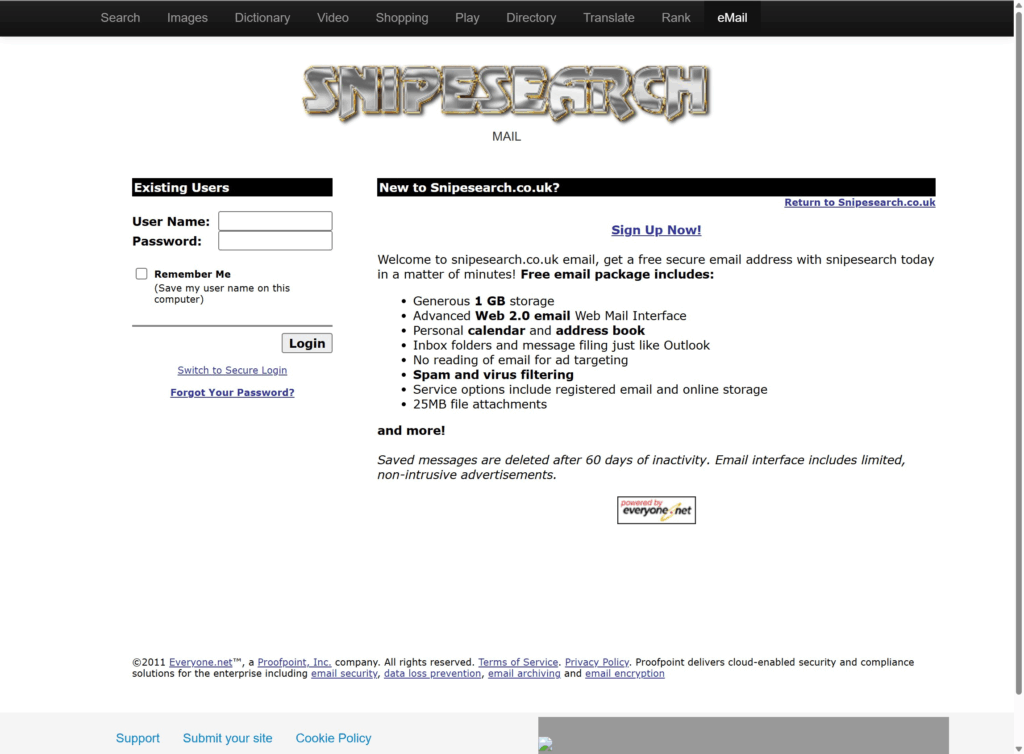
SnipeSearch Mail had provided users with professional-grade email communication as a viable alternative to mainstream providers. Analysis of historical snapshots from 2013-2016 reveals a service deeply integrated into the SnipeSearch brand identity, marketed as ‘free secure email address’ with Web 2.0 webmail interface designed to mirror desktop clients like Outlook.
The service offered robust features: 1GB storage (generous for the era), personal calendar and address book, inbox folders and message filing, spam and virus filtering, 25MB file attachments, and critically, a privacy claim of ‘no reading for ad targeting’ – distinguishing it from Gmail’s content-scanning advertising model.
However, SnipeSearch Mail wasn’t built on sovereign infrastructure. It was ‘powered by everyone.net,’ a provider of SaaS messaging solutions. This co-branded relationship allowed SnipeSearch to offer sophisticated email without building and maintaining dedicated mail servers – a common strategy for mid-sized search engines and ISPs at the time.
The partnership had appeared stable for years, surviving the acquisition of Everyone.net by Proofpoint, Inc. in October 2009. During this ‘Golden Era,’ the service was a pillar of the SnipeSearch brand, contributing to its image as a comprehensive digital portal offering search, mail, dictionary, and social utilities.
But the seeds of shutdown were sown after Proofpoint’s acquisition. As Proofpoint prepared for its IPO, due diligence reviews uncovered potential export violations involving web-based email services provided through Everyone.net to users in restricted countries like Iran. These regulatory risks, combined with increasing costs of managing spam and network abuse, made ‘free’ and ‘co-branded’ service models unattractive to a multi-billion dollar enterprise security firm.
By early 2016, the Everyone.net infrastructure suffered systemic abuse. In May 2016, technical reports detailed abuse of Everyone.net MX servers being used to relay spam, leading to widespread blacklisting on services like DroneBL. Communication from Proofpoint senior technical support engineers indicated the company was attempting to ‘remediate several issues’ by discontinuing free email service – effectively pruning the legacy partner network to protect core enterprise business.
The definitive termination occurred between late 2016 and March 2017. Infrastructure researcher Alexander Maassen noted on December 20, 2016, that Proofpoint officially confirmed discontinuation of free email service. For co-branded services like SnipeSearch Mail, the ‘termination forever’ date was set for March 23, 2017.
The impact on SnipeSearch users was catastrophic. Because Everyone.net ‘turned off’ relations with minimal warning and no clear data migration path, users who had relied on SnipeSearch Mail for years suddenly found accounts inaccessible. Reports describe total lack of support from both Everyone.net and Proofpoint – phone lines unanswered, support tickets ignored. Users lost years of personal and historical data.
This was a ‘devastating blow to the brand’ and the final proof that collaborative partnerships are inherently unreliable. This painful lesson would fundamentally shape future infrastructure decisions: never again would critical services rely on external partners who could arbitrarily terminate service, destroying user data and brand reputation in the process.
The SnipeSearch Mail collapse reinforced the value of the 2015 infrastructure sovereignty pivot. Services built on owned hardware and controlled infrastructure – search, social networking, music streaming – survived and thrived. Services built on external partnerships, regardless of how stable they seemed, were vulnerable to decisions completely outside organizational control.
July 26, 2016: Snipesocial Migration to Dedicated Domain
On July 26, 2016, the social networking wing transitioned to snipesocial.co.uk, providing dedicated domain infrastructure enabling independent scaling without conflicting with search services. This migration represented strategic thinking about service separation: social networking has different traffic patterns, resource requirements, and scaling characteristics than search infrastructure.
The dedicated domain enabled implementation of social-specific optimizations: real-time update infrastructure for feeds, websocket connections for instant messaging, media hosting optimized for user-generated content, and database structures designed for social graph queries rather than web crawling and indexing.
Throughout late 2016, social posts documented rapid feature development. December announcements detailed upcoming January 2017 rollout: video calls, SMS messaging, marketplace functionality, advanced advertising, affiliate programs, events system, and mobile-friendly interface updates.
Posts showcased specific features: ‘Coming soon to snipesocial: Ridiculously large emoticon library for messages,’ reaction systems including like, love, haha, wow, sad, and angry, affiliate earning programs (‘earn prizes and cash for bringing your friends’), and post boost capabilities allowing users to amplify content reach through non tracking promoted posts.
December 2, 2016: Indie BETA Launch
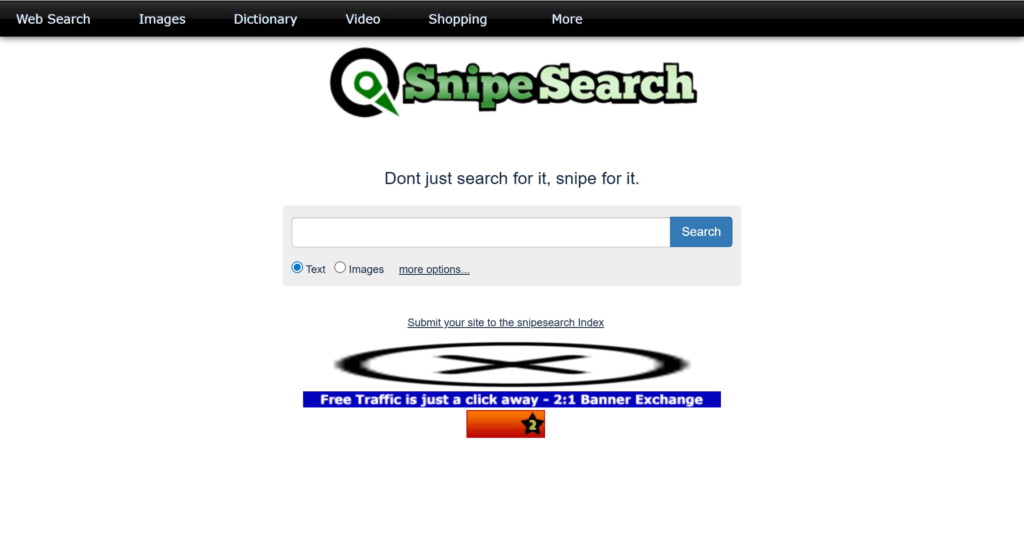
Indie BETA launched at indie.snipesearch.co.uk using Sphider Pro, serving as the organization’s first large-scale experiment in decentralized web indexing before full YaCy integration. This portal provided testing ground for alternative search architectures exploring what search could become when freed from traditional centralized models.
The Indie BETA represented iterative approach to technical evolution: rather than immediately committing to full YaCy P2P architecture, the organization tested decentralized concepts through Sphider Pro implementation, gathering operational data and user feedback before making larger architectural commitments.
2017: Privacy Philosophy, Mobile Apps, and Decentralized Architecture
News Curation Throughout 2017
Throughout 2017, @Snipesearch functioned as sovereign news curator, distributing automated digests covering political shifts (Theresa May’s ECHR stance, Jeremy Corbyn ordering Labour MPs to vote for Article 50 on January 19), infrastructure events (Piccadilly Circus lights shutdown for maintenance January 16), economic indicators (the infamous Freddo chocolate bar price rise to 30p on January 13 – a moment of genuine British cultural significance), and regional transport disruptions across the UK.
This curation served dual purposes: demonstrating the search platform’s capability to identify and surface high-signal news events, while providing value to the Snipesocial community through curated information flows bypassing mainstream media gatekeepers.

March 9, 2017: Android App Launch
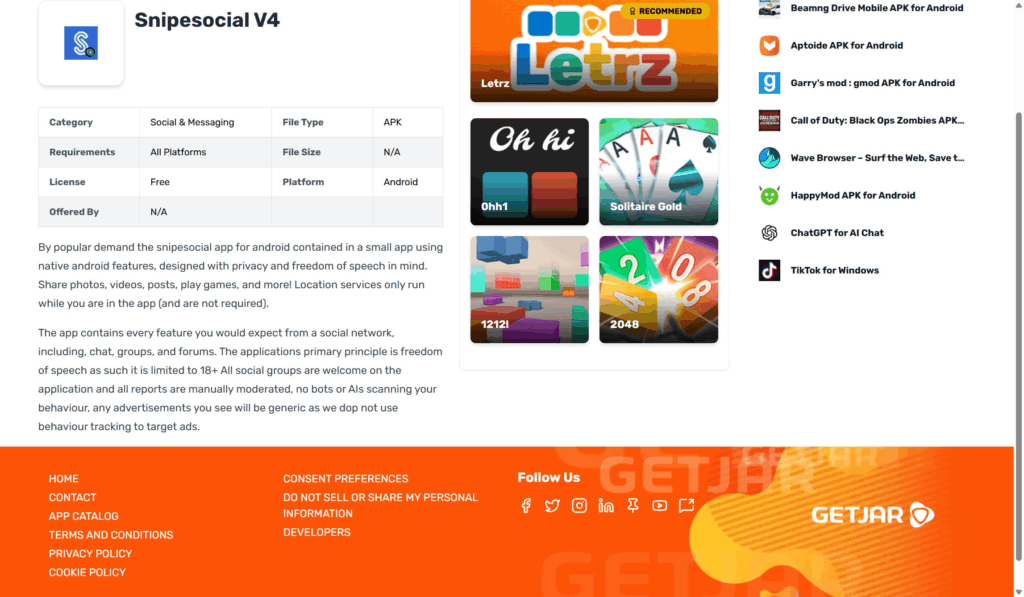
March 9, 2017 marked Snipesocial’s entry into mobile platforms with the Android app launch on GetJar app store. This began an eight-year run that would continue through 2025, demonstrating remarkable longevity for a mobile application.
The mobile presence was critical for user retention and engagement. Social networking increasingly occurred on mobile devices, and platforms without mobile apps risked losing users to competitors offering seamless mobile experiences. The GetJar distribution channel provided alternative to Google Play Store, aligning with the organization’s philosophy of avoiding dependence on major platform gatekeepers.
The Android app supported core social features: news feed browsing, post creation with media attachments, messaging, notifications, and profile management. The application maintained feature parity with web interface while optimizing for mobile interaction patterns and constrained bandwidth scenarios. Today Snipesocials app is available via Ark as GetJar experienced a major restructuring.
September 25, 2017: Privacy Philosophy Articulation
September 25, 2017 brought comprehensive social post outlining what made Snipesocial revolutionary, articulating privacy philosophy in detail: ‘We don’t sell your data to advertisers, the only ads we display are based on page content, not your personal data. We don’t monitor your instant messages. You will never try to share a link via instant messenger and have it blocked or ask for captcha; private messages should be private.’
The post detailed nuanced content moderation approach: allowing nudity (recognizing the human body as natural) while blocking gore (protecting users from traumatic content without warning), enforcing no hate speech policies while refusing to take action against merely offensive memes except for direct attacks on individuals.
This philosophy required active human moderation rather than algorithmic content filtering. Moderators had to evaluate context, intent, and harm rather than simply keyword-matching for prohibited content. The organization chose to invest in moderation infrastructure (evidenced by November 2019’s moderators panel feature) rather than implementing automated censorship inevitably producing false positives and negatives.
The post referenced an explanatory video and promoted both music.snipesearch.co.uk and video.snipesearch.co.uk as ad-free alternatives to mainstream platforms. This integrated marketing positioned the entire SnipeSearch ecosystem as privacy-respecting alternative to surveillance capitalism business models.
December 1, 2017: YaCy Integration and Distributed Search
December 1, 2017 represented the technical culmination of decentralization efforts with YaCy integration. By integrating YaCy’s open-source federated search engine, SnipeSearch distributed data across peer-to-peer network where each node maintained its own index while contributing to and querying the collective network.
This architecture fundamentally differed from traditional search engines. Rather than maintaining single centralized index that could be surveilled, manipulated, or seized, YaCy distributed search data across multiple nodes in peer-to-peer network. No single entity, including SnipeSearch itself, could access or control the complete dataset.
The YaCy implementation provided mathematical privacy guarantees rather than policy promises. Even if SnipeSearch wanted to surveil user searches (which it didn’t), the distributed architecture made comprehensive surveillance technically impossible without compromising majority of network nodes.
The decision to adopt YaCy carried performance costs. Distributed search is inherently slower than querying centralized index. Network latency increases. Result consistency varies based on which nodes respond. But these technical trade-offs bought genuine privacy protection rather than privacy theater.
Infrastructure Sovereignty: The Dynamic DNS Period
During 2015-2020, the flagship snipesearch.com domain remained held by premium domain resellers with asking prices ranging from $26,900 to $50,000. Founders Stephen Driver and Nick Lange refused these valuations, choosing to maintain .co.uk flagship while ensuring the self-funded project remained debt-free.
The refusal to overpay for snipesearch.com represented patient capital discipline: the domain was valuable, but not $50,000 valuable when that capital could instead fund infrastructure, development, or service expansion. Operating on .co.uk and alternate domains (.net, .info, .asia) forced excellence in service delivery rather than relying on brandable domain to carry substandard platform.
The system utilized dynamic DNS hostnames mapping residential server IPs to reachable services. Key dates mark this infrastructure persistence: December 4, 2017 brought renewal notices for snipesearch.hopto.org; May 22, 2018 implemented system-wide GDPR compliance updates aligning zero-tracking policy with European regulations; April 2, 2020 saw expiration of snipesearch.ddns.net, signaling transition toward permanent dedicated infrastructure.
Operating on residential infrastructure with dynamic DNS forced operational excellence. Every performance issue was immediately visible to users. There was no hiding behind Cloudflare’s edge network or AWS infrastructure guarantees during this period (though Cloudflare would be adopted later for bandwidth optimization). The system had to work well on self-managed hardware with residential bandwidth constraints.
This constraint-driven excellence meant that when transition to permanent dedicated infrastructure occurred in 2020, it was backed by years of operational knowledge: understood traffic patterns, known failure modes, code optimized for residential bandwidth limitations, monitoring systems assuming nothing.
May 22, 2018: GDPR Compliance
May 22, 2018 GDPR compliance updates required extensive documentation and policy alignment, but the core technical architecture already aligned with GDPR principles. The platform hadn’t been tracking users in ways requiring fundamental systems changes – instead, GDPR compliance involved formalizing existing privacy practices and providing users with explicit controls and transparency.
The GDPR implementation included: explicit consent mechanisms for data collection, clear privacy policies explaining data usage, user rights to access stored data, deletion capabilities allowing users to remove accounts and associated data, and data minimization principles limiting collection to operationally necessary information.
For platforms built on surveillance capitalism models, GDPR compliance required painful architectural changes. For SnipeSearch, built from the beginning on privacy-first principles, GDPR primarily required documentation proving what the system already did: not tracking users, not selling data, not monitoring communications beyond what was necessary for service delivery.
2019: GIF Support and the Massive November Feature Rollout
January 3, 2019: GIF Posting
January 3, 2019 brought GIF posting capabilities with simple announcement: ‘That’s right we now have Gif posting!’ This expanded Snipesocial’s multimedia capabilities beyond static images and video, enabling users to share animated reactions, memes, and visual content in more expressive ways.
GIF support required implementation of upload processing for animated images, database storage for GIF metadata, thumbnail generation for feed previews, and bandwidth optimization for serving animated content efficiently. While technically simpler than video streaming, GIF support added another dimension to user expression and engagement.
November 28, 2019: The Great Feature Rollout
November 28, 2019 represented one of the largest platform updates in Snipesocial’s history. The announcement detailed dozens of new features implemented that week, demonstrating sophisticated development capacity and mature technical processes.
Social Features:
Post Reactions system (like, love, haha, yay, wow, sad, angry) providing emotional expression beyond simple binary like; trending hashtags surfacing popular topics; memories showing content from previous years on same date; discover posts algorithm surfacing content from outside user’s immediate network; popular posts highlighting high-engagement content; poke system enabling playful user interactions with privacy controls; gifts system allowing users to send virtual gifts with privacy settings.
Visual Customization:
Colored posts enabling text posts with background colors for emphasis; profile backgrounds allowing users to personalize their profile pages beyond default design; new publisher icons modernizing content creation interface.
Communication Features:
Video and audio calls implemented in beta for specific users, representing massive technical undertaking with WebRTC implementation, STUN/TURN server configuration, bandwidth management, and call quality optimization; chat typing status showing when other user was composing message; chat seen status indicating when messages had been viewed.
Content Management:
Videos tab for profiles, pages, groups, and events creating dedicated video content sections; video and audio view counts tracking engagement metrics; new video player (fluidplayer) replacing previous implementation with modern streaming interface; custom video thumbnails allowing content creators to choose representative images; delete stories functionality for removing temporary content; photo deletion from photos page enabling users to manage uploaded images.
Administration and Moderation:
Moderators panel providing dedicated interface for content moderation teams; unusual login detection identifying access from unfamiliar locations or devices with admin controls to enable/disable feature; group and event post approval systems allowing administrators to review content before publication; log out of all sessions security feature enabling users to terminate all active logins; admin shortcuts for profiles, pages, groups, and events streamlining moderation workflows; mark all reports as safe batch operation for managing false-positive abuse reports.
Monetization Infrastructure:
Affiliates percentage from package prices enabling revenue sharing; bank transfer options for affiliate and points withdrawal providing payout flexibility; custom payment options supporting alternative withdrawal methods; wallet credit for pro-package purchases allowing users to buy premium features with accumulated platform currency; comprehensive notification systems for payment approvals and declines keeping users informed of transaction status.
Technical Improvements:
Support for MySQL v8+ ensuring database compatibility with modern versions; updated Google and Twitter authentication APIs maintaining social login functionality; developer apps platform enabling third-party integrations; new 404 error page design improving user experience for broken links; GDPR newsletter consent ensuring compliance with email communication regulations.
Internationalization:
Portuguese (Brazil) and Greek language support expanding platform accessibility to new linguistic communities.
The scale of this update was remarkable. Implementing video calls, payment processing, affiliate systems, and dozens of social features simultaneously while maintaining platform stability required: sophisticated development processes with parallel feature teams, comprehensive testing infrastructure catching regressions before production deployment, database migration strategies managing schema changes without downtime, and rollback procedures enabling quick recovery from deployment issues.
This wasn’t startup throwing features at wall hoping something stuck. This was mature technical organization executing comprehensive product roadmap with professional development practices.
2020: Cloudflare Integration, Crisis Infrastructure, and Cryptocurrency Exploration
January 3, 2020: Cloudflare Adoption
January 3, 2020 brought strategic infrastructure shift with Cloudflare adoption announced via social post: ‘Cloudflare has helped me save 7 GB in the last month.’ This represented pragmatic decision to use edge caching and CDN services reducing bandwidth costs on residential infrastructure while maintaining control over core systems. (Long gone are the days where a 7GB saving seemed like a lot).
The Cloudflare integration was strategic rather than comprehensive. Unlike platforms moving entirely to cloud infrastructure, SnipeSearch used Cloudflare specifically for bandwidth reduction and DDoS protection while keeping search indexes, user databases, and core services on self-hosted hardware.
This hybrid approach balanced cost optimization with infrastructure sovereignty. Cloudflare handled: static asset caching reducing origin server load, DDoS mitigation protecting against volumetric attacks, SSL termination offloading encryption overhead, and global edge distribution improving latency for international users.
Meanwhile, SnipeSearch maintained sovereign control over: search indexes and crawling infrastructure, user databases containing account information, social networking data and relationships, payment processing and financial systems, and email/messaging infrastructure.
The 7GB monthly bandwidth savings represented significant cost reduction on residential internet connection with bandwidth caps or metered billing. For self-funded operation, every pound saved on bandwidth could be reinvested in storage, processing power, or service development.
June 11, 2020: Cryptocurrency Mining Promotion
June 11, 2020 saw social posts promoting cryptocurrency mining through MinerGate: ‘Mining was once for pros or people with dedicated miners now its easy! Step 1. Click the link and sign up. Step 2. Download and install the miner. Step 3. Open the miner and click smart mine.’
This represented exploration of decentralized finance concepts and alternative revenue models. Cryptocurrency mining aligned philosophically with the organization’s emphasis on decentralization, technical sovereignty, and alternatives to traditional financial systems.
The MinerGate promotion demonstrated willingness to experiment with emerging technologies and monetization models. While mining may not have become primary revenue source, the exploration showed openness to technological innovation and diversification beyond traditional advertising and subscription models.
The Digital State Established
By December 2020, the transformation was complete. What began as newly sovereign infrastructure had become fully operational Digital State characterized by comprehensive service portfolio, proven infrastructure resilience, community trust, and sustainable revenue systems.
Infrastructure Foundation:
Self-hosted search and social infrastructure running on owned hardware providing complete technical control; ISP-level network control through PCGUYS registration enabling network-layer sovereignty; federated YaCy architecture preventing centralized manipulation through distributed P2P network; GDPR-compliant zero-tracking backed by actual architecture rather than policy promises; SSL/TLS encryption protecting all user interactions from network-level surveillance; hybrid Cloudflare integration optimizing costs while maintaining sovereign control over critical systems.
Service Portfolio:
Web search with multiple specialized indexes serving different content types and user needs; music streaming with hundreds of thousands of ad-free tracks competing on privacy rather than catalog size; video search and hosting providing alternative to YouTube’s advertising-dominated model; social networking with video calls, comprehensive features rivaling mainstream platforms while maintaining privacy commitments; advertising platforms delivering verified human traffic at demonstrable cost advantages over mainstream networks; affiliate and monetization systems providing multiple revenue streams beyond advertising; payment processing infrastructure supporting various withdrawal methods and wallet functionality.
Revenue Sustainability:
AdClicks delivering verified human traffic at £0.10 per click versus £0.79 industry effective cost, providing 87% cost advantage to advertisers while maintaining platform profitability; affiliate programs providing alternative revenue streams and user monetization opportunities; payment processing infrastructure supporting bank transfers, custom payments, and wallet systems; promotional campaigns ($25 vouchers) demonstrating confidence in platform effectiveness through investment in user acquisition.
Painful Lessons and Strategic Wisdom
The SnipeSearch Mail catastrophe (2016-2017) taught brutal lesson about partnership dependence – Everyone.net/Proofpoint termination destroyed years of user data with minimal warning, devastating brand reputation and user trust. This experience reinforced infrastructure sovereignty philosophy: critical services must run on owned infrastructure where external parties cannot arbitrarily terminate service. The refusal to overpay for snipesearch.com ($26,900-$50,000 asking prices) demonstrated patient capital discipline – investing in capability rather than branding shortcuts. Operating on dynamic DNS (hopto.org, ddns.net) through residential infrastructure forced operational excellence that served the organization well when transitioning to permanent dedicated infrastructure.
The 2015-2020 period established SnipeSearch’s operational DNA:
infrastructure independence over platform dependence, verified quality over apparent volume, patient capital over growth-at-any-cost, operational excellence under constraint, privacy through architecture rather than policy, professional reliability over consumer engagement metrics, and painful awareness that partnerships, however stable they appear, can collapse instantly with catastrophic consequences.
When snipesearch.com was finally reclaimed in April 2026, it joined ecosystem that had already proven these principles could build sustainable systems in industry designed around opposing values. The missing domain became validation of existing success rather than foundation for hoped-for success.
The five years from 2015 to 2020 transformed SnipeSearch from independent search engine into fully operational Digital State with genuine infrastructure sovereignty, proven revenue models, professional adoption, architectural privacy guarantees, and hard-won wisdom about the critical importance of owning the entire technical stack. This foundation would support ecosystem’s continued expansion through the 2020s and enable eventual flagship domain reclamation not as rescue of struggling project, but as natural completion of platform that had already succeeded on its own terms.