SnipeSearch Mail, what happened?
The historical trajectory of SnipeSearch, a digital ecosystem established in January 2005, is defined by a fundamental evolution from a residential experimental project into a sovereign “digital state” characterized by decentralized infrastructure and an uncompromising “Zero-Trust” philosophy.
This transition was not merely a strategic choice but a necessary response to a several catastrophic failures in collaborative partnerships, one notably the sudden and unceremonious termination of co-branded email services by Everyone.net between 2016 and 2017.
The total loss of user data during this period served as a catalyst for our continued withdrawal from external dependencies, leading to a contemporary state of technical sovereignty where every component of the technology stack, from hardware clusters to network bandwidth, is held under direct internal control.
The Philosophical Foundation of Zero-Trust in Search Architecture
The concept of “Zero-Trust” within the SnipeSearch organization extends beyond standard cybersecurity definitions. While traditional IT frameworks define Zero-Trust as a security model requiring strict identity verification for every person and device trying to access resources on a private network, SnipeSearch applied this logic to our operational existence.
For us, Zero-Trust is synonymous with operational independence and technical sovereignty. It is a philosophy born from the realization that in a digital economy dominated by massive tech monopolies and opaque service providers, any external dependency is a potential point of failure.
Our history is punctuated by collaborative partnerships that more than once resulted in the loss of assets, domains, or user trust. These failures were not merely technical glitches but structural betrayals where partners prioritized their own regulatory compliance, corporate acquisitions, or financial pivots over the integrity of the SnipeSearch ecosystem.
The eventual decision to refuse any replacement of the email server until it could be accomplished without external partners reflects our deep-seated commitment to user protection. This infrastructure design has led to a 2026 status where we operate our own ISP and sovereign server clusters, ensuring that no single external entity can unilaterally “kill” a service or erase user history.
The Architectural Genesis: Mum Knows and the Luton Roots (2005–2009)
SnipeSearch originated in January 2005 as a residential project in Luton under the code name “Mum Knows,” utilizing a Compaq ProLiant ML570 server to develop high-performance indexing. This formative era validated the core principles of technical precision and structural logic that continue to govern the organization’s ranking models in 2026.
Condensed History of the Orbit Partnership (2009–2012)
The 2009–2011 partnership with Orbit introduced an external meta-system that eventually proved not to be cost-effective due to escalating development and hosting fees. Upon the dissolution of the partnership, Orbit retained the primary snipesearch.com domain asset rather than transferring ownership to the organization. This resulted in the domain being held by premium resellers for a “ransom” as high as $50,000. SnipeSearch refused to pay these costs, leading to a definitive shift toward absolute technical sovereignty and the Zero-Trust architecture that defines our contemporary infrastructure.
The Longevity and Architecture of SnipeSearch Mail (2011–2016)
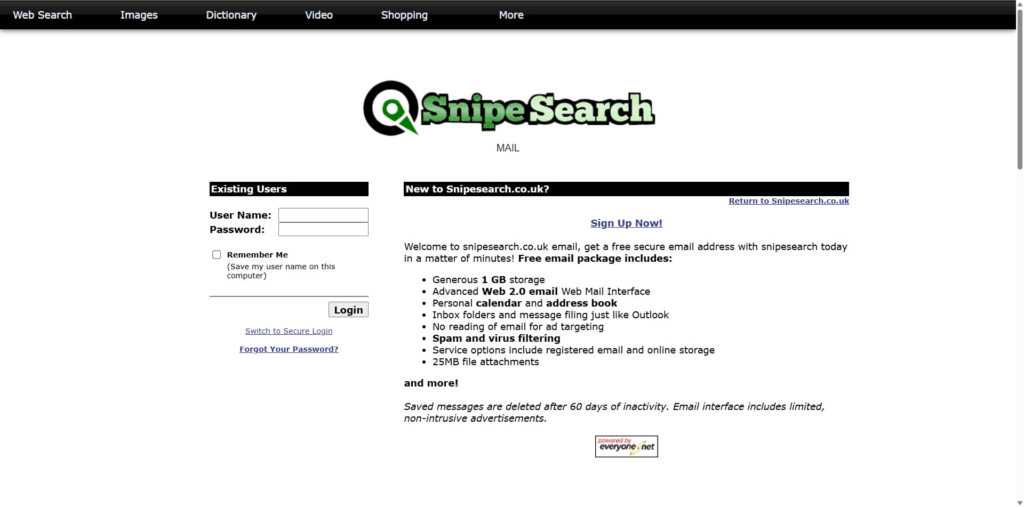
The SnipeSearch Mail service was a central component of the ecosystem’s functional diversification during the early 2010s. For years, the service provided users with a robust, professional-grade communication tool that served as a viable alternative to mainstream providers. Snapshots from 2013 through 2016 show the service was deeply integrated into the SnipeSearch brand identity, positioned as a core utility in the primary site navigation alongside search, dictionary, and video verticals .
Feature Set and User Interface Analysis
The SnipeSearch Mail interface was marketed as a “free secure email address” that users could obtain in a matter of minutes. The service offered a “Web 2.0” webmail interface that was designed to mirror the functionality of desktop clients like Outlook, providing a sense of familiarity for professional users .
The primary technical features of the “Free email package” included:
- 1 GB of Storage: A competitive offering designed to match established webmail services.
- Personal Calendar and Address Book: Moving the service beyond simple message transport into a personal information management tool.
- Inbox Folders and Message Filing: Enabling complex organization of communications.
- Spam and Virus Filtering: Utilizing Everyone.net’s underlying security signatures to protect user accounts.
- 25MB File Attachments: Supporting the exchange of large documents and media.
- No Reading for Ad Targeting: A significant privacy claim that distinguished SnipeSearch from competitors like Gmail.
A critical detail found in the service terms was the policy that “Saved messages are deleted after 60 days of inactivity” . This policy was because while the service was robust, it operated under strict resource management guidelines imposed by the infrastructure partner, a subtle indicator of the external constraints that would eventually lead to the service’s demise.
The Mechanism of the Everyone.net Partnership
The SnipeSearch Mail service was “powered by everyone.net,” a provider of Software as a Service (SaaS) messaging solutions. This co-branded relationship allowed SnipeSearch to offer a sophisticated email platform without the immediate need to build and maintain its own mail servers, a common strategy for mid-sized search engines and ISPs at the time. For years, this partnership was stable, surviving the acquisition of Everyone.net by Proofpoint, Inc. in October 2009. During this era, the service was a pillar of the SnipeSearch brand, contributing to our image as a comprehensive digital portal.
The Death of SnipeSearch Mail: The Everyone.net Termination (2016–2017)
The collapse of SnipeSearch Mail was part of a systemic retreat by Everyone.net and its parent company, Proofpoint, from the co-branded and free email market. The “death” of the service occurred in phases, starting with deteriorating network quality and ending with the total termination of legacy accounts and the loss of user data.
The Proofpoint Acquisition and Regulatory Pressures
The seeds of the shutdown were likely sown shortly after Proofpoint acquired Everyone.net in 2009 for the purpose of integrating its SaaS messaging capabilities into a broader enterprise security portfolio. As Proofpoint prepared for its Initial Public Offering (IPO), due diligence reviews uncovered potential export violations involving the provision of web-based email services through Everyone.net to users in restricted countries, such as Iran. These regulatory risks, combined with the increasing costs of managing spam and network abuse, made the “free” and “co-branded” service models less attractive to a multi-billion dollar enterprise security firm.
The DroneBL Controversy and Network Rot
By early 2016, the Everyone.net infrastructure was suffering from systemic abuse. In May 2016, technical reports detailed the abuse of Everyone.net MX servers, which were being used to relay spam. This led to widespread blacklisting of Everyone.net IP addresses on services like DroneBL. Communication from Proofpoint senior technical support engineers, such as Elvin Carbonel, indicated that the company was attempting to “remediate several issues” by discontinuing its free email service. This “remediation” was effectively a decision to prune the legacy partner network to protect the core enterprise business.
The Final Termination and Data Loss
The definitive termination of the co-branded service occurred between late 2016 and March 2017. Infrastructure researchers noted on December 20, 2016, that Proofpoint had officially confirmed the discontinuation of the free email service. For co-branded services like SnipeSearch Mail, the “termination forever” date was set for March 23, 2017.
The impact on the SnipeSearch user base was catastrophic. Because Everyone.net “turned off” the relations with minimal warning and no clear path for data migration, users who had relied on SnipeSearch Mail for years suddenly found their accounts inaccessible. Users lost years of personal and historical data, an event that the organization describes as a “devastating blow to the brand” and the final proof that collaborative partnerships are inherently unreliable.
Lessons Learned and the Future of Sovereign Mail
The “death” of SnipeSearch Mail at the hands of Everyone.net was the most painful lesson in our organization’s history, but it also became the most significant driver for our current success. The primary takeaway was that collaborative partnerships in the digital space are inherently parasitic; the smaller partner provides the brand and the users, while the larger partner provides the infrastructure that they can “turn off” at any moment for their own convenience or regulatory safety.
The Zero-Trust Operational Mantra
From the Everyone.net disaster, SnipeSearch learned that:
- Ownership is the Only Security: If you do not own the server, the code, the domain, and the network connection, you do not own your service.
- User Data is a Sacred Trust: Losing user emails was a “devastating blow” because it broke the fundamental promise of a digital service provider. To prevent this from ever happening again, the organization will not replace the mail server until it can guarantee that no third party has the power to delete a single message.
- Signal Consistency over Hype: The 20-year signal loop, from the 2005 “Mum Knows” staircase server to the 2026 EPYC clusters, demonstrates that longevity is built on document structure and real-world signal data, not speculative “black box” models.
The Path Forward for SnipeSearch Mail
While the SnipeSearch Mail service remains currently offline in its co-branded form, our organization’s trajectory toward technical sovereignty includes a future where a fully self-hosted mail solution will eventually emerge. The current infrastructure, which includes sovereign server clusters, provides the necessary components to build a mail system that is resilient against corporate betrayal. Until that system can be deployed with 100% internal control, the organization remains a “Zero-Trust” entity, prioritizing the long-term safety of its users over the short-term convenience of a partner-provided utility.
The transition from a vulnerable project to a persistent “Digital State” is now complete. The reclamation of the Snipesearch.com domain in 2026 marks the completion of a 20-year signal loop. SnipeSearch stands as a model for how independent digital ecosystems can survive and thrive in an age of corporate consolidation by embracing absolute technical sovereignty and an uncompromising Zero-Trust philosophy.