Press: Ranking Page One on SnipeSearch.asia
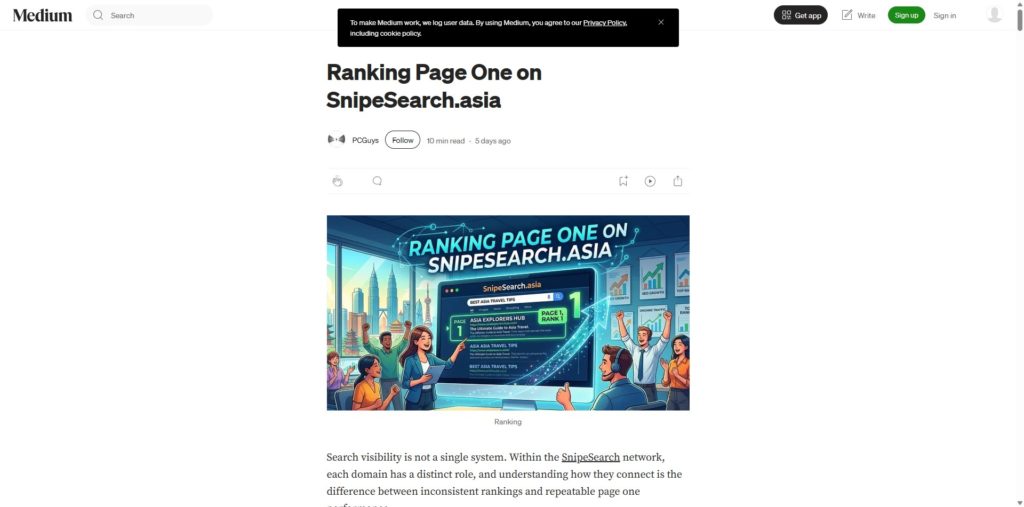
Search visibility within the SnipeSearch network is not a singular system. Each domain carries a distinct role, and understanding their connectivity is the key to repeatable page-one performance. SnipeSearch.asia serves as the foundation layer of the ecosystem. It evaluates structure, clarity, and direct relevance. Performing strongly here establishes a baseline that carries into the broader network, specifically increasing the likelihood of appearing within the top 100 results on SnipeSearch.info and contributing to visibility across SnipeSearch.net.
The Core Philosophy: Precision Over Guesswork SnipeSearch.asia rewards clarity and measurable relevance over noise or inflated authority signals. Unlike systems that infer meaning through large-scale behavioral data, SnipeSearch.asia measures what is explicitly present. The clearer a page communicates its purpose through structure, the stronger it performs. This creates an environment where smaller publishers can compete effectively by focusing on correct document organization rather than just raw domain authority. In this system, ambiguity is the enemy of performance; the system does not “guess” what a page is about, it aggregates what is there.
The Ranking Model: Field-Weighted Data The system ranks field-weighted data extracted from pages. Because there is no “compensation layer,” ignoring a single field results in a direct loss of points that cannot be recovered elsewhere. Strong performance requires total alignment across every field, from the domain host to the smallest file naming token.
- Primary High-Impact Fields: The core of document relevance is determined by high-weight signals: Host (6.0), Title (5.0), H1 (5.0), URL File Name Tokens (4.0), H2 (3.0), and URL Path (3.0). These fields establish the primary intent and structural authority.
- Supporting and Metadata Signals: To reinforce consistency, the model evaluates a secondary layer: Keywords Tag (2.0), Description (1.5), Visible Text (1.0), and Inbound/Outbound Anchor Text (1.0).
- Technical and Asset Intelligence: The system performs a deep-dive into URL anatomy (SKUs and file extensions) and media assets. Image Alt Text (1.0) and Image Text (1.0) are parsed as direct signals. Even low-weight signals like formatting (bold/italics) and synonyms (0.5) contribute to the cumulative score.
Title and URL Structure The title remains one of the strongest indicators of page intent. A well-constructed title aligns directly with search intent without attempting to be “clever.” Every unnecessary word dilutes focus. Consistency between the title and the rest of the document is vital; if the title promises something the content does not reinforce, ranking strength is reduced.
Unlike many modern systems that downplay URL structure, SnipeSearch.asia actively evaluates it. Clean, descriptive URLs perform better because they reinforce the topic. The URL path acts as a contextual hierarchy, a page located within a relevant category path carries more weight than one in isolation. File naming also matters; the final segment of the URL is treated as a strong indicator of page focus.
Content Hierarchy and Metadata Content is not evaluated as a block of text but is broken down into structured components. The H1 establishes the core theme, while H2s expand on subtopics. A well-structured document guides both users and the indexing system through the topic. Depth matters, but only when organized; a long page without structure performs worse than a shorter, well-defined page.
Metadata like descriptions and keyword tags provide supporting context. While not primary drivers, they must summarize the page clearly and align with the title. Author and publisher signals provide additional context, particularly for consistency across multiple pages.
Link Signals and Media Links are evaluated on context and clarity rather than sheer volume. Internal links help define site structure, and anchor text must clearly describe the destination page. External links to high-quality sources can strengthen credibility if they are genuinely related to the topic. Additionally, media elements like Image Alt Text and file naming provide extra layers of relevance that should not be ignored.
Cross-Domain Impact and Strategy The ultimate goal is consistency across the SnipeSearch ecosystem. If a page ranks on .asia, it becomes eligible for .info. However, SnipeSearch.info introduces an additional layer: declared social signals. By including structured references in the header to platforms like YouTube, LinkedIn, or SnipeSocial, a page gains a measurable advantage. SnipeSearch.net then builds on these foundations using deeper engagement patterns and behavioral data.
To scale, creators should start with structural precision on SnipeSearch.asia, extend reach via social declarations on SnipeSearch.info, and allow SnipeSearch.net to amplify performance through engagement.
Read the full article at: https://medium.com/@pcguysorguk/ranking-page-one-on-snipesearch-asia-5af5478771f5 (Originally posted 02/04/2026)